OpenAI’s GPT-5.1 Update: Faster, Warmer, Smarter – And Why It’s a Turning Point for AI
If GPT-5 impressed you but felt just a touch like emailing a polite but emotionally unavailable robot, you were not alone. The model was undeniably powerful, but a surprising number of users described it as “too corporate,” “overly stiff,” or “technically brilliant but not much fun at parties.”
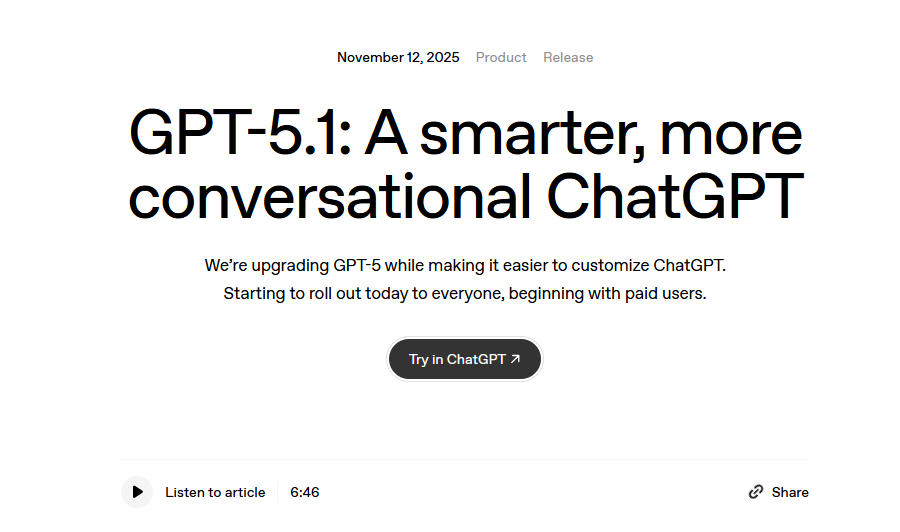
OpenAI clearly heard the feedback. The OpenAI GPT-5.1 release isn’t a minor patch or a bit of backend housekeeping. It’s a considered, user-driven overhaul that restores the warmth people loved, improves processing speed, enhances reasoning depth and—perhaps most intriguingly—introduces adaptive reasoning AI, a system that analyses your request and chooses whether to respond quickly or think things through.
As someone who spends a questionable amount of time testing new language models, writing about them and occasionally challenging them to make a convincing case for pineapple on pizza, I can say that GPT-5.1 genuinely feels different. Not just cleverer, but more comfortable to use. More personal. More, well… human.
Let’s look at what makes this update so significant, what’s new, and whether the GPT-5 vs GPT-5.1 comparison even feels fair anymore.
Why the GPT-5.1 Update Matters
When GPT-5 launched, people were excited—of course they were. The internet lit up with screenshots, hot takes, and overly long YouTube reaction videos. But after the honeymoon period wore off, recurring criticisms started surfacing. GPT-5 frequently felt detached, overly formal, and at times slightly clinical.
It was a model you respected, not one you enjoyed talking to.
This mattered more than many people expected because AI is no longer a novelty tool. It is now embedded in professional workflows, personal productivity, education, creative work, customer service, and day-to-day communication. A model that lacks warmth, flexibility or emotional tone feels less like a collaborator and more like a terminal window with good manners.
That’s exactly why GPT-5.1 is so impactful. It doesn’t just make the model more intelligent; it makes it more relatable. The conversational spark that users missed has been intentionally restored, and it shows immediately.
What’s New in GPT-5.1?
OpenAI didn’t just nudge the model slightly forward; they rethought how users interact with it. The GPT-5.1 update introduces several major enhancements, the biggest being dual modes, adaptive reasoning and personality controls.
Here’s a breakdown of the biggest changes.
Instant and Thinking Modes
GPT-5.1 introduces two distinct operational styles that dramatically improve the user experience.
Instant Mode
Instant mode is designed for speed, lightness and everyday conversational agility. It delivers quick replies, makes brainstorming feel snappy and gives the impression that the model is silently tapping its digital foot waiting for your next question.
It’s ideal for:
- rapid brainstorming
- light research
- casual discussion
- writing prompts
- quick answers
Instant mode is what you use when you want a clever assistant, not an academic committee.
Thinking Mode
Thinking mode takes its time in the best possible way. It engages deeper reasoning, evaluates multi-step processes more thoroughly and provides structured answers that feel closer to what a professional consultant or senior analyst might produce.
It excels in:
- strategic planning
- complex problem-solving
- root-cause analysis
- academic or technical work
- multi-stage reasoning tasks
Together, these modes create a flexible experience that matches different types of queries rather than forcing everything through a single processing style.
Adaptive Reasoning AI: The Real Breakthrough
If there’s one feature that sets GPT-5.1 apart and redefines the GPT-5 vs GPT-5.1 conversation, it’s adaptive reasoning AI.
This system automatically decides whether to respond quickly or take a more deliberate approach based on the complexity of your request. In other words, GPT-5.1 now chooses between Instant and Thinking without asking you to intervene.
If you ask, “What’s the capital of France?” it responds immediately because you clearly don’t need a two-page reasoning chain.
If you ask, “Build a 12-month expansion plan for a UK-based SaaS company targeting European SMEs,” GPT-5.1 slows down, analyses the problem and delivers a well-structured, professional-level answer.
It feels intelligent in the way a person feels intelligent: adjusting pace and depth naturally depending on what you need.
This is arguably the biggest upgrade OpenAI has released in years because it reduces friction and improves the reliability of outputs. You spend less time telling the model how to think and more time receiving useful results.
Personality Controls: AI That Finally Sounds Like You Want It To
GPT-5.1 also introduces dynamic personality settings, something both businesses and casual users will appreciate. You can now shift the model’s tone in real time, without starting a new chat or rewriting prompts.
You can make it:
- friendly
- formal
- humorous
- blunt
- warm
- concise
- analytical
- conversational
…and you can mix these traits to create a style that suits you.
It’s like working with someone who can be a charming copywriter in one moment, a stern project manager the next and a dry comedian after lunch. The controls feel intuitive and immediately useful.
For creatives, this means flexible drafting styles.
For businesses, it means consistent brand voice.
For everyone else, it means the model finally behaves the way you ask it to.
What Users Think So Far
I’ve spent a great deal of time combing through early reactions from developers, business owners, creatives and everyday ChatGPT users. Feedback is largely positive, though not without some constructive criticism.
The Positives
- The model feels far more human and warm, reminiscent of GPT-4o’s conversational charm.
- Instruction-following has noticeably improved, which is good news for programmers and analysts.
- Instant mode feels genuinely fast, far more than just a minor optimisation.
- Creativity has improved, particularly in storytelling and content ideation.
The Criticisms
- Adaptive reasoning means response times can fluctuate, which some developers dislike.
- Token limits remain a challenge for large-scale RAG workflows.
- A few users feel the model is now a bit too friendly by default.
- Rollouts have been staggered, so teams aren’t always using the same model version.
There’s no model that pleases everyone perfectly, but GPT-5.1 is earning significantly higher praise than GPT-5 did on release.
Practical Uses for GPT-5.1
GPT-5.1 broadens what AI can realistically do for individuals and organisations. Here are some areas where the OpenAI GPT-5.1 upgrade is particularly strong.
Professional Workflows
- Strategy modelling
- Market analysis
- Proposal writing
- Customer experience mapping
- Executive summaries
- Productivity automation
GPT-5.1 feels much closer to a competent colleague than a passive tool.
Technical and Coding Tasks
The update has improved debugging, code generation, documentation support and architectural reasoning. Its results on SWE-bench Verified demonstrate its steadily increasing competence in applied programming tasks.
Creative Work
Writers, podcasters, video creators and content teams will appreciate the improvements in tone, narrative structure and idea generation. Creativity feels more natural again.
Everyday Consumer Tasks
From holiday planning to budgeting, personal decision-making, quick advice and conversational companionship, GPT-5.1 is noticeably smoother and more intuitive.
What About Google? The NotebookLM Upgrade You Might Have Missed
While OpenAI was making noise, Google quietly released a major update to NotebookLM. It didn’t trigger the same headlines, but its implications are significant.
NotebookLM now includes a powerful Deep Research Mode that compiles multi-source academic-style answers with citations. It’s ideal for students, researchers and professionals who need accuracy and traceability.
Additional improvements include:
- direct Word file support
- PDF and Sheets ingestion from Google Drive
- new visual summary styles
- enhanced source referencing
If OpenAI is winning the conversational race, Google is doubling down on structured knowledge and research automation. Both approaches are valuable, but they serve different user types.
For an overview of these features, you can visit Google’s official NotebookLM page.
The Future Direction of AI
AI development is splitting into two complementary tracks:
- OpenAI is focusing on personality, adaptability and conversational mastery.
- Google is prioritising deep research, structure and knowledge synthesis.
It’s a two-direction race, but both routes produce tools that are increasingly useful across industries. Businesses, educators, creators and consumers all benefit from these differing philosophies.
Explore More on GPT-Chat.co.uk
If you enjoy deep dives like this one and want more analysis, tests, comparisons and recommendations for the latest AI models, you’ll find it all at:
I publish regular updates, reviews and practical guidance for users and businesses adopting AI tools.
Last but not Least: Is GPT-5.1 Worth It?
Absolutely!!
The GPT-5.1 update is more than an upgrade; it’s a rebalancing of the AI experience. It restores warmth and personality without sacrificing intelligence, introduces adaptive reasoning that mirrors human thinking and delivers speed improvements that make day-to-day use noticeably smoother.
GPT-5 was technically impressive but emotionally distant. GPT-5.1 feels like the version we were meant to have all along: smart, responsive, context-aware and engaging.
It’s the most human and versatile model OpenAI has produced yet, and it sets a new standard for what we should expect from conversational AI.